
Responsible Gambling India Guide
Responsible gaming is not a separate warning placed at the bottom of a casino website. For Rummy Gold India, it should work as a practical player protection page that explains how users can manage time, deposits, emotions, account activity and expectations before gambling becomes uncontrolled. Indian players often access gaming platforms through mobile devices, fast payment tools and short entertainment sessions, so the responsible gaming section needs to be clear, direct and useful rather than formal or decorative.
The main idea is simple: real-money play should remain entertainment. A player should understand how much they are willing to spend, how long they plan to stay active, and when they should stop. The platform can offer tools and guidance, but the user also needs a stable routine. Responsible gaming starts before the first deposit, not after a difficult session.
Before using the Login page regularly, players should know how to protect their account, check balance history and review previous transactions. This helps them avoid emotional decisions and gives them a clearer view of their own activity. A responsible player does not rely on memory alone. They review numbers, set limits and treat each session as a planned entertainment expense.
Why Responsible Gaming Matters for Indian Players
India’s online gaming audience is highly mobile-driven. A user can register, deposit and start playing within minutes. That convenience is useful, but it also creates risk when players act too quickly. Fast access can make repeated deposits feel casual, especially when UPI, cards or banking apps are already part of daily life.
Responsible gaming helps slow that process down. It reminds players to think before adding more funds, to pause after losses, and to avoid treating gambling as a way to solve financial problems. The strongest platforms do not only promote games; they also explain how to use them safely.
For Rummy Gold India, this page should speak to real user behaviour. Some players may join for rummy tables, others may explore casino-style categories, and others may focus on promotions. Each type of player needs the same foundation: money control, session control and emotional control.
A responsible gaming page should not make unrealistic promises. It should not say that all risk can be removed. Risk is part of real-money gaming. What the page can do is help users reduce avoidable harm by making better decisions before pressure appears.
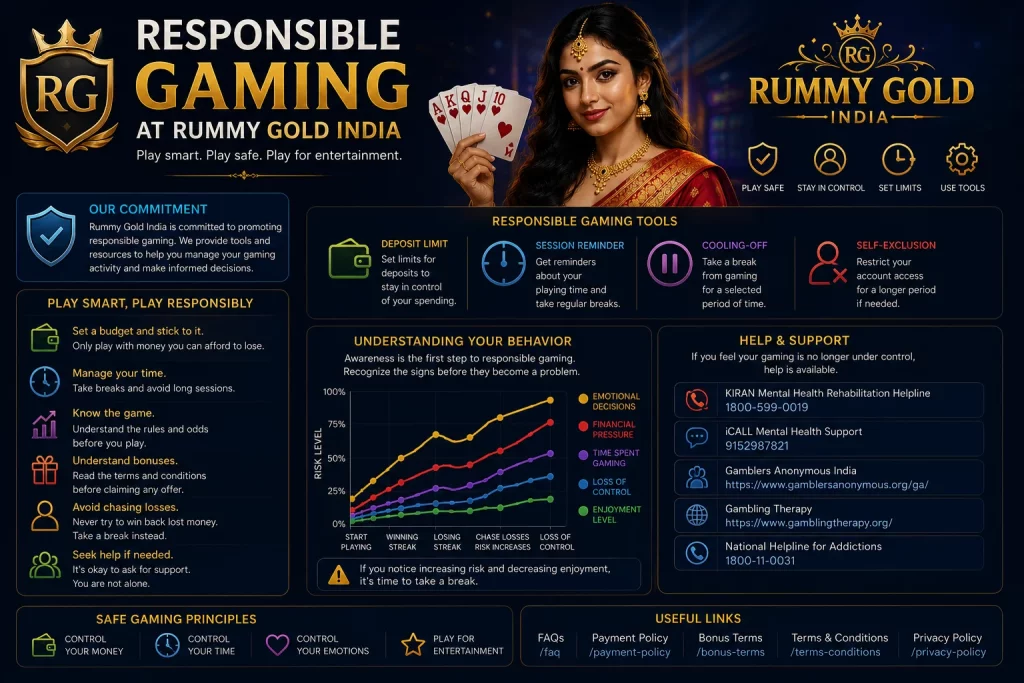
Main Responsible Gaming Tools
The most useful tools are the ones that players can understand quickly. Deposit limits help users decide how much they can add to their account over a selected period. Session reminders help users notice how long they have been active. Cooling-off options allow users to step away temporarily. Self-exclusion tools are more serious controls for users who need a longer break.
These tools work best when they are visible and easy to activate. If a player has to search through too many menus, the protection system becomes weaker. Responsible gaming should be part of normal account management, not hidden behind technical pages.
Players should also treat payment history as a responsible gaming tool. Reviewing deposit patterns can show whether spending is increasing too quickly. If deposits become more frequent after losses, that is a signal to stop and reassess. Good platforms should encourage this kind of review.
Responsible Gaming Control Table
Filter the table to review practical control tools that can support safer play at Rummy Gold India.
| Tool | Purpose | Best Used When | Player Benefit |
|---|---|---|---|
| Deposit Limit | Controls how much money can be added within a period. | Before regular real-money sessions begin. | Reduces impulsive reloading. |
| Session Reminder | Shows how long the user has been active. | During longer mobile or desktop sessions. | Improves time awareness. |
| Cooling-Off Period | Allows a temporary break from gaming activity. | After emotional losses or uncontrolled play. | Creates distance from pressure. |
| Self-Exclusion | Blocks access for a longer selected period. | When gaming is no longer manageable. | Supports stronger intervention. |
| Transaction Review | Lets players monitor deposit and withdrawal history. | Weekly or after every active period. | Shows real spending patterns. |
Emotional Control During Real-Money Play
Most risky gambling behaviour does not begin with a lack of rules knowledge. It often begins with emotion. A player loses several rounds and wants to recover quickly. Another player wins early and starts increasing stakes because the session feels easy. Both reactions can lead to poor decisions.
Responsible gaming means recognizing these emotional shifts before they control the session. A user should stop when decisions become rushed, when deposits are made only to recover losses, or when play continues despite tiredness. These are not technical issues. They are behavioural signals.
Rummy Gold India should explain this in plain language. Players should not feel that responsible gaming is only for severe cases. It is useful for everyone who plays with real money. Even experienced players can make poor decisions when emotions become stronger than planning.
This is especially important when users move from rummy tables to faster casino-style content. Some formats create quicker decision cycles than others. Fast rounds may feel exciting, but they can also reduce reflection time. A player should understand the pace of each game before increasing stakes or extending a session.
Responsible Use of Promotions
Promotions can be part of a gaming platform, but they should never become the reason to ignore spending limits. A Bonus may include wagering requirements, expiry periods, eligible games and withdrawal restrictions. If a player activates an offer without reading the conditions, the promotion can create confusion instead of value.
Responsible players should treat promotional funds as conditional entertainment, not guaranteed profit. They should check whether the bonus fits their normal play style and budget. If the required activity is higher than they planned, skipping the offer may be the better decision.
A professional platform should explain this clearly. It should not present every promotion as something every user must claim. Some offers are useful only for certain players. Others may not match a user’s preferred budget or game category.
This is where internal linking should feel natural. The responsible gaming page can guide users toward the bonus terms page, but it should do so as part of risk awareness, not as aggressive promotion.
Risk Awareness Across Different Game Types
Different games create different user behaviours. Rummy-style play may involve decision-making, memory and timing, while casino-style products may rely more heavily on probability and random outcomes. Players should understand these differences before deciding how much time or money to use.
The Games section can help users explore available categories, but responsible gaming explains how to approach them. A player should ask practical questions before starting: how fast is the game, how much can be lost in one session, how easy is it to pause, and whether the format encourages repeated quick decisions.
The aim is not to discourage entertainment. The aim is to keep the player aware. Good gaming habits depend on realistic expectations. No game should be treated as income. No streak should be treated as proof of future results.
The chart below shows how responsible gaming awareness should grow before and during platform use.
Building a Safer First Session
A safer first session should be planned before play starts. The user should decide a budget, choose a time limit and understand the game category. They should also know where to find account history and support options if something feels unclear.
During Sign up, accurate personal details matter. A user who enters incorrect information may face problems later during verification or withdrawals. Responsible gaming is connected to account integrity because clear identity, safe payments and controlled access all reduce future friction.
Players should also avoid using borrowed payment methods or shared accounts. Even if a deposit works, withdrawal checks may become complicated. A responsible account should belong to one person, with matching details across profile, payment method and verification documents.
The first session should not be treated as a test of luck or income potential. It should be treated as a controlled introduction to the platform. A player who starts with structure is more likely to keep control later.
Responsible Gaming and Financial Awareness
Financial control is one of the strongest indicators of responsible gambling behaviour. Players who track deposits, understand their spending patterns and set realistic limits usually experience fewer emotional decisions during sessions. Responsible gaming is not only about stopping harmful behaviour after it begins. It is also about preventing unstable habits from developing gradually over time.
For Indian users, this topic is especially relevant because digital payments are now deeply integrated into everyday routines. Deposits through UPI, banking apps and mobile wallets can happen within seconds. That convenience improves usability, but it can also reduce reflection time when emotions are high. A responsible player should therefore approach every deposit as a planned decision rather than a reaction to frustration or excitement.
Rummy Gold India should encourage users to review transaction history regularly instead of focusing only on gameplay results. A player may feel that spending is under control, but balance history often reveals patterns more accurately than memory alone. Repeated small deposits during emotional sessions can become difficult to notice without reviewing actual records.
Financial awareness also means separating entertainment spending from essential expenses. Gaming balances should never depend on money needed for bills, savings or daily responsibilities. Responsible gambling works best when the user already accepts the possibility of losing the planned session budget before play even begins.
Understanding Chasing Behaviour
One of the clearest signs of risky gambling behaviour is chasing losses. This happens when a player continues depositing or increasing stakes mainly because they want to recover money quickly. Chasing behaviour is emotional, not strategic. It often becomes stronger after frustration, fatigue or impulsive decision-making.
The problem is not only financial. Chasing losses also changes how players think during sessions. Decisions become rushed, breaks disappear and bankroll planning loses importance. Instead of evaluating the next round logically, the player begins focusing only on recovery.
Responsible gaming systems should explain this openly. Many users think loss chasing affects only inexperienced players, but emotional pressure can influence anyone. The strongest defence is awareness before the situation develops.
A player who notices repeated urgent deposits, emotional reactions after losses or longer sessions than originally planned should stop and reassess. Responsible gambling tools become most useful at this stage because they interrupt momentum before the behaviour becomes harder to control.
Some users also move between different categories during emotional sessions, switching from rummy formats to faster casino-style Slots or similar games because they believe speed will improve recovery chances. In reality, rapid switching usually increases instability instead of improving outcomes.
How Session Limits Improve Decision-Making
Session limits are often underestimated because they look simple. In practice, they are one of the most effective responsible gaming tools available. A clear session limit creates structure before emotions begin influencing behaviour.
A user should decide in advance how long they want to remain active. Once the planned time ends, the session should stop regardless of current results. This prevents gaming from gradually expanding far beyond the original intention.
Time awareness matters because long sessions reduce concentration and increase emotional reactions. A player who has been active for several hours may no longer evaluate risks calmly. Fatigue changes judgement even when the player does not immediately notice it.
Responsible platforms should therefore make session reminders visible and easy to understand. Pop-up notifications, activity summaries and clear account timers help users remain aware of how long they have been active.
This is particularly important for players using mobile devices. Smartphone gaming sessions often feel shorter than they really are because the environment is more compact and continuous. A user can easily continue playing while multitasking, travelling or relaxing at home without noticing how much time has passed.
Responsible Gaming Behaviour Table
| Behaviour Pattern | Potential Risk | Recommended Action |
|---|---|---|
| Repeated deposits after losses | Emotional chasing behaviour | Pause the session and review balance history |
| Ignoring session time | Reduced decision quality | Use reminders and scheduled breaks |
| Increasing stakes rapidly | Loss of bankroll control | Return to original planned limits |
| Gaming during stress or fatigue | Impulsive decisions | Delay gameplay until emotional state improves |
| Ignoring account activity | Poor spending awareness | Review transaction history weekly |
Responsible Gaming and Mobile Platforms
Mobile gaming changes player behaviour significantly because access becomes constant. Users can open gaming platforms almost anywhere, which increases convenience but also reduces separation between gambling and normal daily activity.
Responsible gaming pages should therefore discuss mobile behaviour directly. A player should not gamble automatically out of boredom, routine or emotional habit. Gaming sessions should remain intentional rather than becoming background activity throughout the day.
The use of unofficial applications also creates risk. Players downloading modified Apk files from third-party sources may expose themselves to account compromise, stolen payment details or fraudulent software. Safe gaming begins with using official platform versions only.
Mobile notifications should also be managed carefully. Constant promotional alerts can encourage impulsive sessions if the player already struggles with spending control. Responsible users should disable unnecessary notifications if those alerts begin triggering unplanned deposits or emotional play.
Rummy Gold India should frame mobile safety as part of responsible gambling rather than treating it only as a technical issue. Secure devices, stable internet connections and controlled session habits all support healthier long-term behaviour.
Educational Awareness Around Promotions
Promotions can influence behaviour strongly when users focus more on reward size than on real conditions. Responsible gaming means understanding how offers actually work before activating them.
A Bonus may include wagering requirements, expiration periods, game restrictions and maximum withdrawal conditions. These terms affect how promotional balances behave and how quickly funds become withdrawable. Players who ignore these details may become frustrated later, especially if they continue gambling simply to “unlock” an offer.
Responsible gambling pages should therefore explain that declining a promotion is sometimes the smarter choice. Not every offer fits every player. A user with a limited bankroll or short session preference may not benefit from large wagering requirements.
This educational approach makes the platform appear more transparent because it treats users as decision-makers instead of only as customers responding to promotions.
Responsible Gambling and Account Transparency
Players should always understand their own account activity clearly. Deposit history, withdrawal requests, bonus status and active limits should remain visible and easy to access. Confusion creates instability because users stop evaluating their activity accurately.
A responsible gaming page should encourage players to review these sections regularly. Someone who checks balance history only after losses has already lost part of their financial awareness. Monitoring activity consistently creates stronger long-term habits.
This is also why accurate registration matters during Sign up. Clear personal details reduce future verification issues and help maintain account integrity. Shared accounts, borrowed payment methods and incorrect information increase unnecessary complications later.
The platform should encourage one-account usage with matching personal and banking information. Responsible gambling is connected not only to emotional control but also to operational stability.
External Support and Awareness Resources
Responsible gambling support becomes stronger when platforms connect users with broader awareness and educational resources. Indian users increasingly interact with digital financial systems, mobile payments and online entertainment simultaneously, so gaming awareness should exist alongside wider digital responsibility.
Responsible Gaming Resources
Digital Payment Safety
Awareness related to secure online banking and financial activity.
Reserve Bank of IndiaCybersecurity Awareness
Information about safer digital behaviour and online account protection.
CERT-In IndiaDigital Literacy Programs
Educational initiatives connected to responsible digital usage in India.
Digital IndiaRecognising Early Warning Signals
Responsible gambling becomes easier when players recognise behavioural changes early instead of waiting for severe problems. Warning signs can include hiding spending, feeling anxious during losses, ignoring planned limits or treating gambling as emotional escape.
A player does not need to experience every warning sign before taking action. Even one repeated pattern may be enough to justify a break or stronger account controls.
The chart below shows how gambling pressure often increases when emotional behaviour begins replacing planned behaviour.
Responsible Gaming and Long-Term Behaviour
Responsible gambling is not defined by one session. Most risky behaviour develops gradually through repeated habits. A player may begin with controlled entertainment, but over time emotional deposits, longer sessions or constant promotional chasing can slowly replace structured decision-making. That is why long-term awareness matters more than short-term motivation.
Rummy Gold India should explain responsible gaming as an ongoing process rather than a one-time warning. A player who regularly reviews account history, maintains stable limits and takes breaks when necessary usually stays in better control over time. Responsible behaviour is built through repetition, not through isolated reactions after losses.
This also means users should avoid treating gambling as a daily financial routine. Gaming sessions should remain optional entertainment activities instead of becoming automatic habits connected to stress, boredom or emotional pressure. The more automatic the behaviour becomes, the harder it is to evaluate decisions rationally.
Indian players who access gaming platforms frequently through smartphones should pay special attention to routine formation. Mobile access is fast, which means repeated short sessions can accumulate without feeling significant individually. Responsible gaming requires awareness not only of money spent, but also of how often gambling becomes part of everyday behaviour.
Why Transparency Matters in Responsible Gaming
A strong responsible gaming page should never sound vague or overly promotional. Players notice quickly whether a platform explains systems honestly or only uses responsible gaming language as decoration. Real transparency means discussing risk openly, explaining protection tools clearly and making support options easy to access.
Responsible gaming systems should therefore be visible across the platform rather than isolated inside one hidden section. Deposit limits, transaction history, self-exclusion tools and support access should remain connected to normal account management. When protection systems feel difficult to access, players are less likely to use them during emotional moments.
Transparency also applies to payment activity. Users should always understand their own deposit patterns, withdrawal status and promotional conditions. Confusion increases instability because players lose track of how much they have spent or how bonus balances actually work.
This is particularly important for players exploring multiple categories, including rummy tables, live experiences or casino-style Games. Different gaming environments create different behavioural patterns, so users should understand the pace and structure of each format before increasing time or spending.
Responsible Gaming and Account Security
Account protection is closely connected to responsible gambling because unsafe accounts create additional financial and emotional risks. A player who shares credentials, uses weak passwords or downloads unofficial applications increases the chance of account misuse or unauthorised activity.
Users accessing the platform through an Apk should only use official verified sources. Modified or unofficial files may contain harmful code capable of exposing payment information or account credentials. Safe gambling begins with safe access.
Players should also avoid shared accounts or third-party payment methods. Even when there is no harmful intention, shared access creates confusion during verification, withdrawals and support review. Responsible gambling works best when one user controls one verified account with matching personal and banking details.
Security habits also include regular password updates and careful device management. Public devices, unsecured networks and automatic login settings can weaken account protection significantly. A responsible player treats gaming credentials with the same seriousness as online banking access.
Responsible Gaming Awareness Table
| Situation | Possible Risk | Recommended Response |
|---|---|---|
| Playing after emotional losses | Chasing behaviour and unstable decisions | Stop the session and review spending calmly |
| Ignoring account history | Reduced financial awareness | Check deposits and withdrawals regularly |
| Using unofficial applications | Account or payment compromise | Use official platform sources only |
| Continuous long sessions | Reduced concentration and fatigue | Take scheduled breaks and set reminders |
| Relying on bonuses emotionally | Overspending through wagering pressure | Review terms before activating offers |
The Role of Support Systems
Support teams play an important role in responsible gambling environments. Players should feel that they can ask questions about limits, account controls or payment concerns without being pushed toward more deposits or longer activity.
A professional support system responds operationally rather than emotionally. If a user requests a cooling-off period or asks about self-exclusion, the process should be clear and respectful. Responsible gaming support is not about judgement. It is about helping users regain control when necessary.
The responsible gaming section should also explain where users can find additional information. Internal Links to support pages, account settings and payment history help players navigate important tools more easily. The structure should feel practical instead of promotional.
Good support systems also reduce panic during normal account events. Verification reviews, withdrawal checks and session limits should be explained calmly so users understand why they exist. Confusion often creates unnecessary emotional reactions that make gambling behaviour less stable.
Understanding Promotional Pressure
Promotions affect different users in different ways. Some players treat offers casually, while others feel pressure to continue gambling because a reward is active. Responsible gaming pages should explain this openly.
A Bonus should never become the reason to exceed a planned budget. If the wagering requirement feels unrealistic or encourages excessive play, the offer may not be appropriate for that user. Responsible gambling means understanding when declining a promotion is the better choice.
This is especially relevant for newer users who may interpret promotional balances as “free money.” In reality, bonus systems usually include conditions affecting withdrawals, eligible categories and gameplay requirements. Players should read terms carefully before activating any reward structure.
Platforms that explain these mechanics honestly appear more trustworthy because they prioritise clarity over pressure-based marketing.
Recognising Behavioural Changes Early
The earlier players notice behavioural changes, the easier it becomes to regain control. Responsible gambling problems rarely appear instantly. They usually begin through smaller repeated patterns: longer sessions, emotional deposits, frustration after losses or constant thoughts about recovering money.
Users should therefore monitor their own behaviour honestly. If gaming starts affecting mood, sleep, finances or relationships, stronger intervention may be necessary. Breaks, self-exclusion tools or outside support may become important at that stage.
Rummy Gold India should present responsible gaming as a normal part of healthy platform use rather than something associated only with severe situations. The majority of responsible gambling behaviour comes from prevention, not crisis management.
FAQ
What is responsible gaming?
Responsible gaming means managing gambling activity in a controlled way through limits, awareness and realistic financial expectations.
Why are deposit limits useful?
Deposit limits help players control spending before emotional decisions begin affecting gameplay behaviour.
Can bonuses affect responsible gambling habits?
Yes. Some players continue gambling longer because they want to complete wagering requirements or recover promotional losses.
Why should players avoid unofficial Apk files?
Unofficial applications may expose account credentials, payment details or device security to unnecessary risk.
What should players do if gambling stops feeling controlled?
Players should take a break, review account activity, use responsible gaming tools or consider self-exclusion options if needed.






Comments