Gambling Addiction Help India at Rummy Gold India
Gambling addiction help should never be treated as a small footer link or a formal disclaimer. For Rummy Gold India, this page should work as a serious support section for Indian users who feel that gambling is becoming difficult to control. A player may begin with casual entertainment, but repeated deposits, emotional decisions, secrecy, borrowing money or constant attempts to recover losses can turn gambling into a harmful pattern.
The goal of this page is not to judge the player. The goal is to help them recognise risk earlier and choose safer actions. Gambling-related harm can affect money, sleep, relationships, study, work and emotional stability. When a user starts feeling that gambling is no longer fully voluntary, it is time to pause and look for support.
Before using the Login area again, a player who feels out of control should step back and review their recent activity. Account history, deposit records and session patterns can show whether behaviour has changed. If gambling has become a way to escape stress, recover losses or chase a previous win, the safer response is not another session. The safer response is distance, support and account controls.
In India, gambling support can involve mental health helplines, addiction services, family support, counselling and digital safety resources. Gambling Therapy describes itself as a global service offering free practical advice and emotional support for people affected by gambling harm, while Tele-MANAS is listed as a Government of India mental health helpline available through 14416.
When Gambling Stops Feeling Like Entertainment
A useful warning sign is not only how much money someone loses. It is also how gambling begins to affect decisions. If a player keeps returning even after deciding to stop, hides activity from family, borrows money to continue, feels anxious when not playing or makes repeated deposits after losses, the issue is no longer ordinary entertainment.
Some users notice the problem only when withdrawals, debts or daily expenses become stressful. Others notice it emotionally: irritation, shame, restlessness or constant thoughts about the next session. These signs deserve attention before the situation becomes more difficult.
Rummy Gold India should present this page as a support route, not as a promotional page. A user looking for help should not be pushed toward Bonus offers, new games or deposit prompts. The page should guide them toward limits, cooling-off, self-exclusion and professional support.
Early Warning Signs and Safer Actions
Gambling Risk Check Table
Use the search field to review warning signs and safer first steps.
| Warning Sign | What It May Mean | Safer First Step | Support Route |
|---|---|---|---|
| Repeated deposits after losses | Possible chasing behaviour | Stop the session and block further deposits | Cooling-off or self-exclusion |
| Hiding gambling activity | Loss of openness and control | Speak to a trusted person | Family support or counselling |
| Borrowing money to play | Financial harm may be increasing | Stop deposits immediately | Financial and addiction support |
| Playing to escape stress | Gambling may be replacing coping skills | Take a break and seek emotional support | Tele-MANAS |
| Unable to stop after deciding to stop | Control may be seriously affected | Use self-exclusion tools | Gambling Therapy |
Why Chasing Losses Is a Serious Signal
Chasing losses is one of the clearest signs that gambling is becoming unsafe. It happens when a player continues mainly because they want to recover money already lost. At that point, decisions are usually driven by pressure rather than entertainment.
The safest response is to stop immediately, not to change the game or increase the stake. Moving from rummy tables to faster formats such as Slots can make the situation worse because quicker rounds reduce reflection time. The user may feel that recovery is close, but this feeling is not a reliable guide.
A support-focused page should explain this directly. A player who is chasing losses does not need more strategy tips. They need interruption, limits and support.
Support Should Be Easy to Reach
Help should be visible before the situation becomes severe. Users should know where to find account restrictions, cooling-off tools, self-exclusion options and external support. The National Toll Free Helpline under India’s Nasha Mukt Bharat Abhiyaan is listed as a source for guidance and support related to substance-use concerns, and NIMHANS has a Centre for Addiction Medicine providing clinical services, training and research in addiction medicine.
This does not mean every gambling concern needs the same response. Some users may need a short break and deposit limits. Others may need stronger account blocks and professional help. The important point is to act early rather than waiting until the harm becomes harder to manage.
Behavioural Pressure Growth
First Steps If Gambling Feels Hard to Control
The first step is to stop adding money. The second step is to create distance from the account. A player can use cooling-off tools, request self-exclusion, disable payment methods where possible and ask a trusted person to help them stay away from gambling triggers.
Users should also avoid installing any new Apk or accessing mirror-style pages during this period. If the goal is recovery, alternative access routes can weaken the break. The safer decision is to remove shortcuts, reduce notifications and avoid gambling-related prompts.
If gambling has started affecting safety, family life, study, work or emotional wellbeing, outside support is important. A person does not need to wait until everything is severe before asking for help. Early support is easier than late repair.
How Gambling Harm Affects Daily Life
Gambling-related harm is often discussed only in terms of money, but the effects usually reach much further. Financial pressure may be the most visible consequence, yet many people first notice changes in mood, concentration, sleep quality or relationships before they notice the financial impact. This is why gambling addiction support should focus on the whole person rather than only on gambling activity itself.
For some users, gambling gradually becomes a source of stress instead of entertainment. Sessions that once felt enjoyable begin creating anxiety. Players may start thinking about gambling during work, studies or family activities. They may become distracted, restless or irritable when unable to play. These behavioural changes often appear long before severe financial problems develop.
Rummy Gold India should encourage players to pay attention to these early signals. A player does not need to wait until debts appear before taking action. The earlier someone recognises that gambling is affecting everyday life, the easier it becomes to restore balance.
In India, many people manage multiple responsibilities at the same time, including education, work, family commitments and financial obligations. Gambling should never interfere with these priorities. When gaming begins replacing responsibilities rather than fitting around them, support tools should be considered immediately.
Emotional Effects of Gambling Problems
One of the least discussed aspects of gambling addiction is emotional exhaustion. Many users focus only on wins and losses, but repeated gambling pressure can create emotional fatigue even when financial harm is not immediately obvious.
Players experiencing gambling-related stress often report feelings of guilt, frustration or disappointment after sessions. Some begin hiding activity from family members or avoiding conversations about money. Others become increasingly preoccupied with previous losses and spend large amounts of time thinking about gambling outcomes.
The responsible response is not self-criticism. Shame often makes gambling problems harder to address because people become reluctant to seek help. A stronger approach is honest recognition. If gambling creates emotional distress, it deserves attention just like any other behaviour affecting wellbeing.
Support systems exist precisely because these experiences are common. Gambling-related harm does not mean a person lacks discipline or intelligence. It means a behaviour has become difficult to manage and may require additional structure or support.
Players who feel overwhelmed should avoid using gambling as a coping mechanism for stress. Gambling is not a solution for anxiety, loneliness, financial pressure or emotional difficulties. When it starts being used in that way, the risk of harm increases significantly.
Family and Relationship Impact
Gambling addiction rarely affects only one person. Family members, partners and close friends are often influenced as well. Trust can become strained when gambling activity is hidden or when financial problems remain undisclosed.
For this reason, support pages should encourage communication rather than secrecy. Speaking honestly with a trusted person is often one of the most effective early steps. External perspectives can help players recognise behaviour patterns that have become difficult to see from inside the situation.
Families also benefit from accurate information. Gambling-related harm is easier to address when everyone understands what is happening. Blame and confrontation often increase tension, while informed support tends to improve cooperation and recovery outcomes.
Rummy Gold India should therefore present gambling help as something that can involve families and support networks, not only individual players. Recovery and behaviour change are often stronger when support comes from multiple directions.
Warning Signs and Support Actions
Financial Warning Signs
Borrowing money, repeated deposits, missed bills or increasing spending beyond planned limits.
Emotional Warning Signs
Anxiety, guilt, irritability, frustration or constant thoughts about gambling activity.
Behavioural Warning Signs
Long sessions, loss chasing, secrecy or difficulty stopping after deciding to stop.
Safer Response
Use account controls, take breaks, seek support and reduce access to gambling triggers.
Why Self-Exclusion Exists
Self-exclusion is one of the strongest responsible gambling tools available. Unlike session reminders or deposit limits, self-exclusion is designed for situations where gambling behaviour has become difficult to manage through ordinary controls.
When activated, self-exclusion blocks account access for a selected period. The purpose is not punishment. The purpose is creating distance. Many players find it easier to regain control when access is temporarily removed rather than constantly available.
A common mistake is viewing self-exclusion as something only for severe addiction. In reality, it can be useful whenever gambling feels increasingly difficult to manage. Early use of strong tools often prevents larger problems from developing later.
Players who choose self-exclusion should also avoid alternative routes back to gambling. Searching for new platforms, installing another Apk or immediately creating replacement accounts weakens the value of the break. The objective is recovery, not temporary interruption.
Gambling and Financial Pressure
Financial stress and gambling can create a difficult cycle. Some users begin gambling because they want extra money. When losses occur, they may gamble more in an attempt to recover. This often increases pressure rather than solving it.
Responsible gambling pages should explain clearly that gambling is not a financial strategy. No game category, promotion or betting pattern can reliably solve financial problems. The safest approach is always to separate gambling decisions from financial emergencies.
This is particularly important when discussing promotions. Some users may become overly focused on a Bonus because it appears to reduce financial risk. In reality, bonus systems still involve conditions, wagering requirements and uncertainty. Promotional offers do not remove the fundamental risks associated with gambling.
Players facing financial difficulties should prioritise practical financial support, budgeting assistance or debt advice rather than increasing gambling activity.
Professional Help and Support Resources
Many people delay seeking help because they believe their situation is not serious enough. In reality, support works best when accessed early. A person does not need to reach a crisis point before talking to a counsellor, support organisation or trusted individual.
India has several mental health and support resources that may help individuals experiencing emotional distress or behavioural concerns. Some services focus on mental wellbeing generally, while others provide addiction-related support or counselling.
Seeking help is not an admission of failure. It is often the first practical step toward regaining control. The sooner someone discusses the issue openly, the more options remain available.
Understanding Risk Escalation
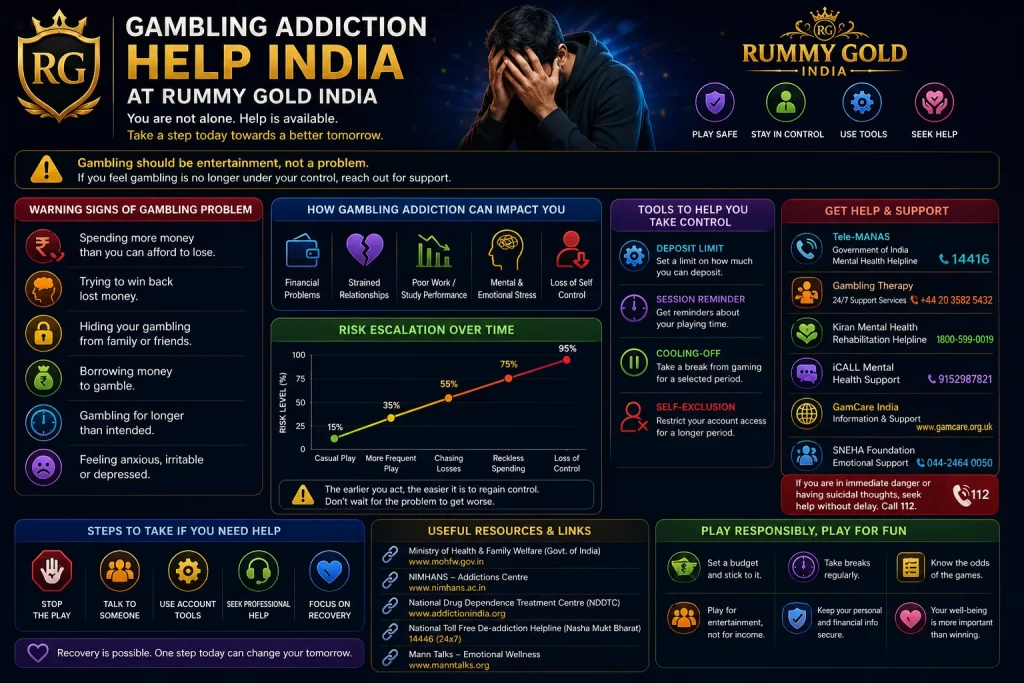
The chart below illustrates how gambling-related pressure can increase when early warning signs are ignored. The goal is not to predict individual outcomes but to show why early intervention matters.
Building Distance From Gambling Triggers
One of the most effective recovery strategies is reducing exposure to gambling triggers. Triggers may include promotional emails, notifications, payment shortcuts, gambling-related social media content or routine habits associated with previous sessions.
Players who want a break should consider removing saved payment methods, disabling notifications and avoiding gambling-focused content where possible. These steps may seem small, but they reduce impulsive decisions significantly.
Support pages should focus on practical actions rather than motivation alone. Motivation changes from day to day. Environmental changes often provide more reliable protection because they reduce temptation directly.
Recovery Is a Process, Not a Single Decision
Recovery from gambling-related harm rarely happens because of one decision alone. Most people regain control through a series of practical changes made over time. These changes may include reducing access to gambling, improving financial oversight, seeking support and building healthier routines outside gaming environments.
Many players expect recovery to feel immediate. In reality, urges, habits and triggers may continue for some time after gambling activity stops. This does not mean recovery is failing. It simply means behaviour patterns take time to change.
For Indian players using mobile devices, recovery often begins by reducing convenience. Fast access, saved payment methods and constant notifications can make gambling difficult to avoid during emotional moments. Creating distance from these triggers gives the brain more time to make deliberate decisions rather than impulsive ones.
A person seeking help should focus on progress rather than perfection. Small improvements repeated consistently usually create stronger long-term results than dramatic short-term promises.
Building a Support Network
One of the most effective protective factors during recovery is support from other people. Gambling problems often become stronger when secrecy increases. Isolation reduces accountability and makes emotional pressure more difficult to manage.
Support can come from family members, friends, counsellors, healthcare professionals or specialised organisations. Different people need different types of support. Some may benefit from practical financial guidance. Others may need emotional support or professional counselling.
Rummy Gold India should encourage users to seek assistance early rather than waiting for a crisis. Talking openly about gambling concerns is often uncomfortable at first, but honest communication frequently reduces pressure and creates more realistic options for change.
Support networks also help users stay accountable. When trusted people understand the recovery goal, they can help recognise warning signs before gambling behaviour begins escalating again.
Financial Recovery and Stability
Financial recovery deserves separate attention because gambling-related harm often affects money management directly. A player who has experienced losses should focus first on stability rather than recovery gambling.
Trying to win money back through additional gambling usually increases risk. Financial recovery works more effectively through budgeting, debt management, spending awareness and gradual rebuilding of financial routines.
Players should review account history honestly and understand how much money has actually been spent. Accurate information is more useful than estimates. Transaction records often provide a clearer picture than memory.
Responsible support pages should also remind users that financial recovery takes time. Quick solutions are rarely realistic. Consistent budgeting and reduced gambling exposure are generally safer approaches than attempting rapid recovery through additional play.
Recovery and Support Resources
Mental Health Support
Access emotional support and counselling when gambling begins affecting wellbeing.
Tele-MANAS IndiaAddiction Support
Professional services can help users experiencing loss of control over gambling behaviour.
Gambling TherapyDigital Safety Resources
Support safer online behaviour and reduce exposure to unnecessary digital risks.
CERT-In IndiaUnderstanding Relapse Triggers
Recovery is rarely a perfectly straight path. Many people experience periods where gambling urges return unexpectedly. These situations are often connected to specific triggers rather than a lack of effort.
Common triggers include financial stress, loneliness, boredom, emotional distress, exposure to gambling advertising or previous gambling routines. Understanding personal triggers makes it easier to prepare for them.
For example, some players feel stronger urges after receiving promotional emails. Others experience difficulty during stressful periods or after receiving unexpected income. Recognising these situations allows users to take preventive action before gambling resumes.
Players who are taking a break should avoid creating new gambling accounts through alternative Sign up routes or searching for replacement platforms. Recovery becomes more difficult when access remains constantly available.
Reducing triggers may also involve removing gambling-related applications, deleting saved payment details and avoiding communities focused primarily on gambling activity.
Creating Healthier Alternatives
Recovery becomes stronger when gambling is replaced with other meaningful activities rather than simply removed. Free time previously spent gambling can be redirected toward hobbies, exercise, social activities, learning opportunities or personal projects.
The goal is not to create constant distraction. The goal is to build routines that provide enjoyment and structure without the same risks associated with gambling.
Some people benefit from physical activities because movement helps reduce stress and improves mood. Others prefer creative projects, reading, education or spending more time with family and friends. Different approaches work for different individuals.
The important point is that recovery becomes easier when positive alternatives exist. Empty time often allows old habits to return more easily.
Protecting Yourself Online
Digital safety also plays a role in gambling recovery. Users attempting to reduce gambling activity should be cautious about installing new applications, following gambling-focused content or interacting with promotional messages.
This includes avoiding unofficial Apk downloads, mirror sites and unsolicited promotional offers. Recovery works best when access becomes less convenient rather than more convenient.
Players should also review notification settings, unsubscribe from unnecessary marketing messages and remove saved payment shortcuts where appropriate. Small technical changes can significantly reduce impulsive behaviour.
FAQ
FAQ
How can I tell if gambling is becoming a problem?
Warning signs can include chasing losses, hiding gambling activity, spending beyond planned limits or finding it difficult to stop after deciding to stop.
What should I do first if I feel out of control?
Stop depositing money, take a break from gambling activity, review account history and consider using cooling-off or self-exclusion tools.
Can gambling problems affect mental wellbeing?
Yes. Gambling-related harm can contribute to stress, anxiety, guilt, sleep difficulties and relationship pressure.
Should I seek help even if my situation is not severe?
Yes. Early support is often more effective because problems are usually easier to address before they become more serious.
Where can Indian players find additional support?
Resources such as Tele-MANAS, addiction support services and professional counsellors can provide additional guidance and assistance.






Comments