
Safe Gambling Tips India
Safe Gambling Tips India: A Practical Guide for Responsible Play
Safe gambling is not about removing entertainment from gaming. It is about making sure that entertainment stays under control. For players in India, online gaming has become easier to access than ever before. Mobile platforms, digital payments, and instant account access mean that a gambling session can start within seconds. While convenience is valuable, it also increases the importance of responsible habits. The most effective gambling strategy is not a betting system or a prediction method. It is a personal safety framework that protects money, time, and decision-making.
At Rummy Gold Casino, responsible gaming should be viewed as an essential skill rather than a warning message hidden at the bottom of a page. Safe gambling begins before a single rupee is deposited. Players who set limits in advance generally make better decisions than those who create limits after losses occur. The difference between entertainment and gambling harm is often not the game itself but the way a player manages risk.
Many Indian players focus heavily on winning opportunities while paying less attention to loss management. This creates an imbalance. A responsible player understands both sides of the equation. Every game includes uncertainty, and no platform can guarantee profit. Safe gambling means accepting this reality before play begins rather than after losses occur.
One of the strongest habits is separating gambling money from essential living expenses. Rent, food, transportation, education, savings, and family obligations should never depend on gambling outcomes. Entertainment budgets should remain independent. When gambling funds are exhausted, the session should end. Chasing losses by using money intended for important responsibilities is one of the most common pathways toward gambling-related harm.
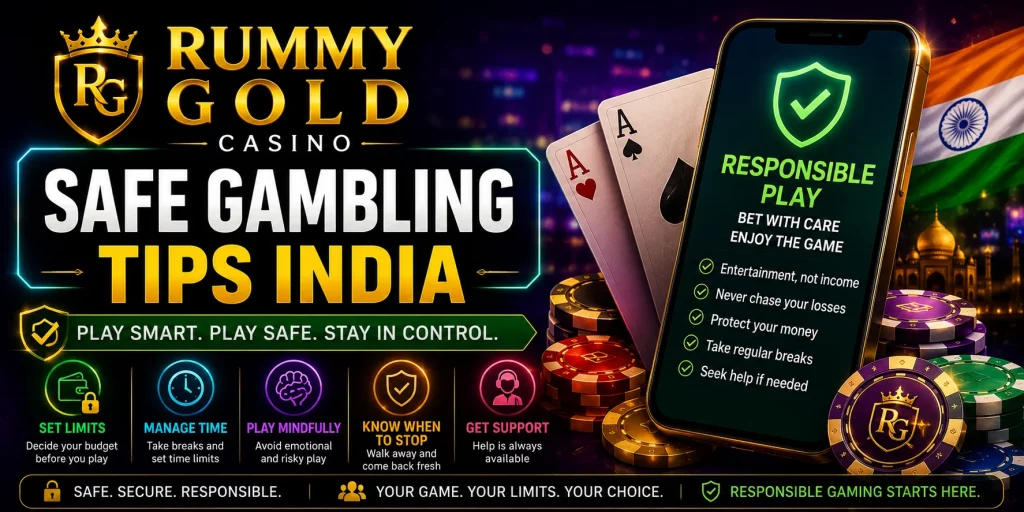
Set Limits Before You Start Playing
One of the most effective responsible gambling techniques is pre-commitment. This means deciding your limits before the game begins. Once gambling starts, emotions often become stronger than logic. Wins create excitement, while losses create pressure. Both situations can influence decision-making.
A safe player decides three limits before opening a game. The first is a money limit. The second is a time limit. The third is a loss limit. These limits should never be changed during the session. If a player increases limits after losses, the original protection system no longer works.
For Indian players using mobile gaming platforms, setting alarms can be surprisingly effective. A simple timer creates a reminder that breaks automatic behaviour. Even experienced gamblers benefit from external reminders because long sessions can distort perception of time.
| Safe Gambling Principle | Why It Matters | Recommended Action | Resource |
|---|---|---|---|
| Budget Control Separate Gambling Funds | Protects household finances and prevents emotional decisions after losses. | Create a dedicated entertainment budget before playing. | Responsible Gaming Foundation India |
| Time Control Session Limits | Long sessions often lead to poorer decisions and loss chasing. | Set a maximum session duration before play begins. | NIMHANS |
| Emotional Awareness Avoid Stress Gambling | Playing during frustration or anger increases impulsive behaviour. | Pause gambling when emotions are elevated. | Tele-MANAS |
| Reality Check Accept Losses | Loss chasing is one of the strongest gambling risk factors. | End the session when the budget is exhausted. | Find a Helpline India |
Understand the Difference Between Entertainment and Income
One of the most dangerous misconceptions in gambling is treating it as a financial strategy. Gambling products are designed as entertainment activities. While wins can occur, they should never be relied upon to pay bills, recover debt, fund investments, or replace employment income.
Players who approach gambling as entertainment generally make calmer decisions. They view wins as positive outcomes rather than necessities. This mindset reduces emotional pressure and lowers the likelihood of chasing losses.
Safe gambling also requires understanding probability. Short-term outcomes can vary significantly, but no strategy can eliminate risk entirely. Players who accept uncertainty usually experience less frustration and fewer impulsive decisions.
Recognising Early Warning Signs
Gambling problems rarely begin with dramatic events. They often develop gradually through small behavioural changes. A player may start spending slightly more time gambling, thinking about gambling more often, or feeling stronger emotional reactions to losses.
Several warning signs deserve attention. These include increasing deposits after losses, hiding gambling activity, borrowing money, neglecting responsibilities, feeling anxious when unable to play, or using gambling as an escape from stress. The earlier these signs are recognised, the easier it becomes to regain control.
Safe gambling is not only about preventing severe harm. It is also about maintaining balance. A player who notices warning signs early can make adjustments before gambling begins affecting finances, relationships, or mental well-being.
Building Long-Term Responsible Gambling Habits
Responsible gambling is most effective when it becomes a routine rather than a reaction. Safe players regularly review spending, track time spent playing, and evaluate whether gambling remains enjoyable. If gambling stops feeling enjoyable and starts feeling necessary, it is time to reassess.
At Rummy Gold Casino, responsible gaming content should help players build habits that remain effective over time. Safe gambling is not a single decision. It is a collection of small decisions repeated consistently. Players who follow structured limits, accept losses calmly, and maintain balance between gaming and everyday life are more likely to keep gambling enjoyable and sustainable.
The strongest responsible gambling strategy is simple: protect your money, protect your time, protect your emotional well-being, and never gamble with funds you cannot afford to lose. When these principles remain in place, gambling is far more likely to remain entertainment rather than a source of pressure.
Why Safe Gambling Depends on Timing and Mood
Safe gambling is not only a question of money. Timing and emotional state matter just as much. A player who gambles after rest, with a fixed budget and a clear time limit, is in a very different position from a player who gambles late at night, after stress, after an argument, or after losing money. The same game can produce very different behaviour depending on the condition of the player.
For Indian players, mobile access makes timing especially important. A session can begin during a commute, after work, before sleep, or immediately after receiving a payment notification. This convenience can make gambling feel casual, but it can also reduce the natural pause that helps people think. Safe gambling means creating that pause on purpose.
The best rule is to avoid gambling when emotions are high. Anger, boredom, anxiety, loneliness, and excitement can all affect judgment. Some players assume that only negative emotions create risk, but excitement after a win can also lead to overconfidence. A responsible player treats strong emotion as a warning sign and delays play until thinking feels calm again.
Choose an entertainment amount before play starts and never increase it during the same session.
Use a phone alarm or platform reminder to stop long sessions before decisions become automatic.
Do not gamble after stress, anger, loneliness, alcohol use, or an urgent desire to recover losses.
When the budget or timer ends, leave the session without trying to repair the result immediately.
The Safer Session Model for Indian Players
A safer gambling session has a beginning, middle, and end. The beginning is where the player sets limits. The middle is where the player monitors behaviour. The end is where the player leaves according to the original plan. Problems usually appear when the end point becomes flexible. A player who keeps extending time or adding money is no longer following a safety model.
Before playing, the player should ask one clear question: can I afford to lose this amount without affecting anything important? If the answer is no, the session should not begin. Safe gambling depends on accepting that the chosen amount may be lost. If losing the amount would cause stress, borrowing, unpaid bills, or conflict, then the amount is too high.
During play, the player should watch for changes in mood. Frustration after a loss, excitement after a win, and impatience during a losing streak are all signals to slow down. Responsible gambling does not require the player to feel nothing. It requires the player to notice when feelings are starting to control decisions.
Safe Gambling Risk Curve
The risk of poor decisions usually increases when time, emotion, and loss pressure combine. The chart below shows a practical risk curve for common session patterns. It is not a clinical measurement. It is a visual reminder that risk rises when the player stays longer, chases losses, or plays under emotional pressure.
Why Loss Chasing Is the Main Habit to Avoid
Loss chasing is one of the clearest signs that gambling is becoming unsafe. It happens when a player continues because they want to recover money already lost. The problem is that the next decision is no longer based on entertainment. It is based on pressure. Pressure reduces patience and increases risk.
A responsible player accepts that a lost budget is the cost of entertainment. This is not always easy, especially when the loss feels unfair or sudden. But accepting the stop point is essential. The more a player tries to reverse a loss immediately, the more likely they are to exceed limits.
Indian players using quick payment methods should be especially careful. Fast transfers make loss chasing easier because the player can add more funds before thinking clearly. Removing saved payment methods and reducing daily transfer limits can make a major difference. Safe gambling often depends on making impulsive action slower.
Building Breaks Into Every Gambling Routine
Breaks are a simple but powerful safety tool. A break interrupts automatic play and gives the player time to check whether they are still making calm decisions. Even a short pause can reveal whether the session is still enjoyable or has become tense.
A useful break routine can be direct. Stand up, move away from the device, drink water, check the time, and review the original limit. If the player feels irritated by the idea of stopping, that is important information. It may mean the session is no longer fully controlled.
Breaks also help reduce the tunnel vision that can happen during fast play. When a person focuses only on the next round, the original budget and time limit can disappear from attention. A break brings those limits back into view.
Responsible Play as a Site-Wide Standard
Safe gambling advice should not appear only on one page. Rummy Gold Casino should make responsible play visible across the site structure. Players should see safety reminders near payment information, account guidance, promotional terms, and game explanations. This creates a more credible user experience because it treats player protection as part of the platform’s editorial standard.
Internal linking should support that structure. A player reading about payments should be able to reach safer-play guidance. A player reading promotional terms should be able to find limit-setting information. A player reading game rules should be reminded that no result is guaranteed. Responsible navigation helps keep the site useful rather than purely promotional.
A real expert casino site does not pretend that risk does not exist. It explains risk clearly and gives the reader practical tools. Safe gambling is strongest when it is specific: decide the budget, set the timer, avoid emotional play, accept losses, take breaks, and ask for help if control becomes difficult.
How to Make Safe Gambling a Personal System
Safe gambling works best when it becomes a personal system rather than a vague intention. Many players tell themselves they will “be careful,” but that phrase is too general to protect money or time. A safer approach is specific. The player knows how much they can spend, how long they can play, when they must stop, and what signs mean the session is becoming risky.
For Indian players, this system should reflect the realities of mobile gaming and fast payments. If access is too easy, limits need to be stronger. If gambling usually happens late at night, the system should include phone-free hours. If losses create pressure to continue, the system should include a strict stop rule. Responsible play is not built around perfect self-control. It is built around practical barriers that still work when motivation is low.
Before You Play
Choose a small entertainment amount and accept that it may be lost before the session begins.
Decide the session length in advance and use an alarm to avoid automatic extended play.
Avoid gambling when angry, tired, lonely, stressed, intoxicated, or trying to escape pressure.
Never use money needed for rent, food, bills, transport, family duties, education, or debt repayment.
During and After Play
Step away after a major win or loss because both excitement and frustration can distort decisions.
When the budget ends, the session ends. Trying to recover immediately usually increases risk.
Check whether gambling stayed calm and optional or began to feel urgent, emotional, or secretive.
If stopping feels difficult, use responsible gaming tools, speak with support, or take a longer break.
Why Payment Discipline Matters in India
Payment discipline is one of the most important parts of safe gambling in India because digital transfers can make gambling feel frictionless. A player who keeps cards, wallets, or instant payment routes saved may be able to add money before thinking clearly. That speed can be dangerous after losses.
A safer habit is to make deposits slower and more deliberate. Removing saved payment details, lowering transfer limits, and separating essential funds can help. These actions are not signs of weakness. They are safeguards. Responsible players do not make risky behaviour easier than necessary.
Payment discipline also protects families. In many Indian households, money may be shared across responsibilities. A gambling decision can affect more than one person if it uses funds needed for bills, education, rent, groceries, or family support. This is why entertainment money should be clearly separated from household money.
How to Review Your Gambling Behaviour Honestly
A responsible player reviews behaviour without excuses. The most useful question is not “Did I win?” but “Did I stay within control?” A winning session can still be risky if the player ignored limits, played too long, or felt unable to stop. A losing session can still be controlled if the player stayed within the planned budget and left on time.
After each session, the player should consider whether the original plan was followed. Was the budget fixed? Was the timer respected? Were losses accepted? Was there any urge to borrow, hide, or immediately continue? These answers matter more than the final result.
Honest review prevents small problems from becoming large ones. If the same warning sign appears repeatedly, the player should adjust the system. That may mean shorter sessions, lower budgets, stronger payment barriers, or a complete break from gambling.
Safer Play Requires Realistic Expectations
No gambling product should be treated as predictable income. A safe player understands that outcomes are uncertain and that losing is always possible. This mindset prevents overconfidence and reduces frustration when results do not match expectations.
Some players create personal systems or patterns and then believe those systems guarantee better outcomes. This belief can be risky. Even when a player understands rules well, uncertainty remains. Knowledge can improve understanding, but it cannot remove risk.
Responsible gambling means accepting uncertainty before play begins. If a person cannot emotionally accept losing the planned budget, the budget is too high or the session should not happen. Safe gambling begins with the ability to walk away without needing to repair the result.
When Safe Gambling Means Not Gambling
The safest gambling tip is sometimes to stop entirely for a period of time. This is especially true when gambling has become linked to stress relief, debt recovery, secrecy, or emotional escape. A break can help the player understand whether gambling is still entertainment or has become a pressure habit.
A break does not need to be presented as a dramatic decision. It can begin with one day, one week, or one month away from gambling. During that time, the player can review spending, remove payment access, block promotional messages, and speak with support if needed.
Rummy Gold Casino should present this clearly. Responsible gambling is not only about playing with limits. It is also about recognising when not to play. A trustworthy casino information site should make that message visible, practical, and easy to act on.
Creating a Safer Gambling Routine That Lasts
Safe gambling is strongest when it becomes part of a routine. A player should not wait until a session feels risky before thinking about limits. Limits should already exist before the account is opened, the payment method is selected, or the first game begins. This is especially important in India, where mobile access and fast payments can make impulsive decisions easier.
A long-term routine should include money rules, time rules, emotional checks, and recovery steps. Money rules protect essential expenses. Time rules prevent long sessions from becoming automatic. Emotional checks help the player avoid gambling during stress, anger, loneliness, or loss pressure. Recovery steps make it clear what to do when gambling stops feeling controlled.
The safest routine is simple enough to follow every time. If the rules are too complicated, they will be ignored during emotional pressure. A practical routine might be: set the budget, set the timer, check mood, play only if the money is affordable to lose, stop when the first limit is reached, and review the session honestly afterwards.
Choose a fixed amount before playing and confirm that losing it will not affect bills, food, rent, transport, education, savings, or family duties.
Decide the maximum play time in advance so the session has a clear end point before excitement or frustration appears.
Avoid gambling during stress, anger, loneliness, fatigue, alcohol use, debt pressure, or a strong urge to recover previous losses.
If either the time limit or money limit is reached, the session ends. A responsible stop point should not be renegotiated during play.
After play, check whether gambling stayed calm and optional or became urgent, secretive, emotional, or harder to stop.
How to Know When a Break Is the Safest Choice
A break from gambling is not a failure. It is often the most responsible decision a player can make. If gambling has started to create tension, secrecy, financial stress, or repeated regret, continuing with smaller limits may not be enough. A full pause gives the player time to think clearly and rebuild control.
A break may be needed when gambling starts to feel necessary rather than optional. This can happen when a player wants to recover losses, escape stress, or feel excitement after a difficult day. If gambling is being used to change mood, the risk is higher. Entertainment should not become emotional medication.
A break can begin with a simple time frame: 24 hours, 7 days, 30 days, or longer. During that time, the player should remove payment access, avoid promotional messages, and speak with support if urges remain strong. The goal is not only to stop gambling temporarily. The goal is to understand what role gambling has started to play in daily life.
Safe Gambling Protection Strength
The chart below shows how different responsible gambling habits contribute to safer play. It is not a medical or legal score. It is a practical visual model showing that protection becomes stronger when several habits work together instead of relying on one rule alone.
Why Responsible Gambling Content Builds Trust
A casino information site becomes more credible when it explains risk clearly. Readers do not need empty promises or generic warnings. They need practical guidance that helps them make safer choices. This is especially important for Indian players, where fast mobile access and digital payments can make gambling feel effortless.
Rummy Gold Casino should treat safe gambling content as part of the site’s main user experience. Responsible play guidance should appear near payment information, game guides, account pages, promotional terms, and help resources. This makes the site feel more serious and more useful because it does not separate entertainment from responsibility.
A trustworthy gambling site does not suggest that play is always the right choice. Sometimes the right choice is to stop, take a break, lower limits, remove payment access, or contact support. Clear responsible gambling content protects the reader and strengthens the site’s authority.
Final Safe Gambling Guidance for Indian Players
Safe gambling begins with one principle: only gamble when the activity is affordable, voluntary, and controlled. If gambling becomes urgent, secretive, emotional, or financially stressful, the safest move is to pause. No offer, feature, or game is worth risking essential money or personal well-being.
Players should keep gambling separate from income goals. It should not be used to pay bills, recover debt, escape stress, or prove skill. Wins can happen, but they should never be treated as expected income. Losses must be accepted as possible entertainment cost, not as problems to repair immediately.
For Indian players, the most practical safe gambling tips are direct: set a budget, set a timer, avoid emotional play, remove fast payment access, take breaks, review behaviour honestly, and ask for support when control becomes difficult. If these habits are followed consistently, gambling is more likely to remain entertainment rather than pressure.






Comments