Rummy Gold India How To Stop Gambling India
Stopping gambling starts with a clear decision that protects money, time, and mental focus. For many Indian players, gambling does not become stressful in one moment. It usually changes slowly: deposits become more frequent, sessions become longer, losses feel harder to accept, and the player begins to think that one more game can fix the previous result. When gambling starts creating pressure instead of entertainment, the safest response is to stop and create distance from the habit.
Rummy Gold India should treat this topic as a responsible gaming guide, not as a promotional page. A player searching for how to stop gambling needs calm, practical steps. They need to understand how to reduce access, block deposits, avoid promotional triggers, and use account protection tools before the situation becomes worse.
A good first rule is simple: do not test control by opening the Login page “just to check”. For a player who wants to stop, even checking an account can restart the habit loop. Familiar screens, saved passwords, wallet buttons, previous results, and account balance reminders can all bring back the urge to play. The safer option is to step away immediately and remove the easiest access points.
Some users also feel that after Sign up, they should continue because the account already exists. That is not true. Creating an account does not create an obligation to keep playing. If gambling feels risky, stressful, or financially uncomfortable, stopping early is the correct responsible decision.
Recognising When Gambling Is No Longer Safe
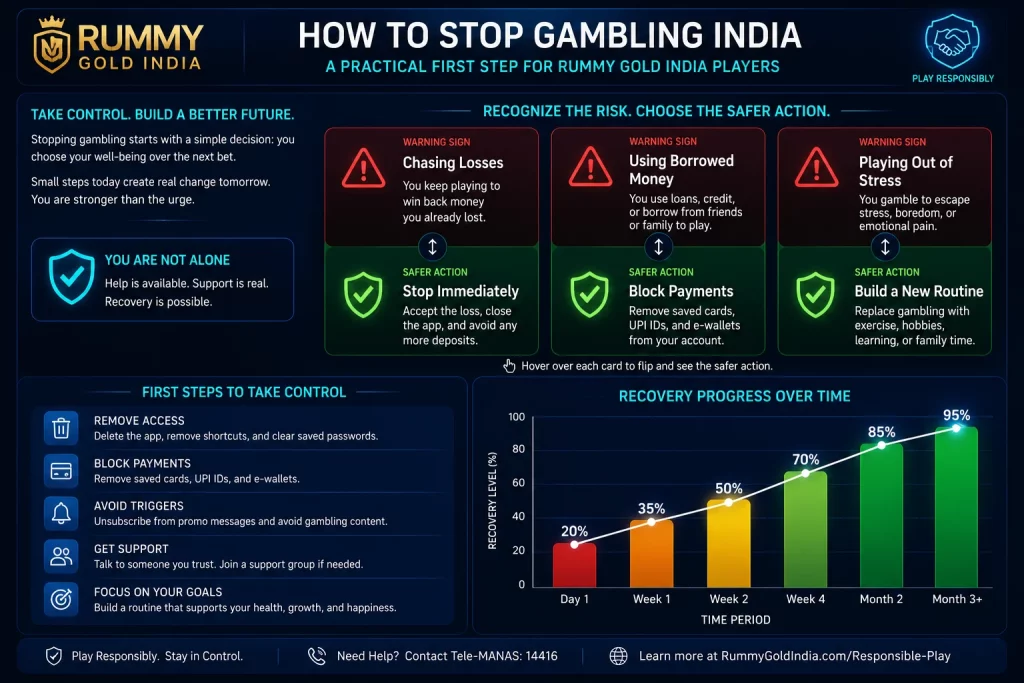
A player does not need to reach a crisis before taking action. Warning signs can appear much earlier. If gambling affects sleep, study, work, family responsibilities, or normal spending, the situation already deserves attention. The strongest warning sign is not the amount of money lost, but the feeling that stopping has become difficult.
Many players continue after a loss because they want to recover money quickly. This is one of the most dangerous patterns. Gambling should never be treated as a financial recovery method. When a person plays to repair previous losses, decisions become emotional, stakes often increase, and the risk becomes stronger.
The table below is the first interactive table for this article. It uses flip-card logic: the front side shows a warning sign, and the back side shows the safer action.
Removing Access Before the Urge Returns
The first practical goal is to make gambling harder to reach. This matters because many gambling habits are automatic. A player may not make a serious decision to gamble. They may simply open a saved page, tap an app icon, check an old message, or follow a payment route they have used many times before.
Removing access changes the environment around the player. It reduces the number of moments where they must rely only on willpower. If the page is not saved, the password is not stored, notifications are off, and deposits are harder to make, the player has more time to pause before acting.
This is why mobile access should be handled early. If the Apk remains on the phone, the habit stays close. Deleting it does not solve everything, but it creates distance. The same applies to saved passwords, browser shortcuts, payment autofill, and promotional notifications.
Players should also avoid switching into other gambling categories after deciding to stop. Moving from rummy into Slots or other fast-play products does not reduce the risk. It keeps the same cycle active, only in another format. A clean break is safer than replacing one gambling activity with another.
After access is reduced, the first few days may feel uncomfortable. This is normal. A person may feel bored, restless, irritated, or tempted to check whether the account is still available. These feelings do not mean the decision was wrong. They usually mean the habit is being interrupted.
The safest response is delay. Wait fifteen minutes before taking any gambling-related action. Leave the device, drink water, take a walk, call someone, or start a planned task. Most urges lose strength when they are not acted on immediately.
Stopping Deposits Before Stopping Thoughts
Many players become discouraged because they still think about gambling after deciding to stop. This is normal. Thoughts can continue for some time, especially when gambling was part of a daily routine. The important point is that a thought does not have to become an action.
Stopping deposits is more urgent than stopping every thought. If payment access is blocked or removed, immediate financial harm becomes less likely. The urge may still appear, but acting on it becomes harder. This gives the player time to step away, contact someone, or move into another activity.
A player should not use borrowed money, emergency savings, family funds, or credit to continue gambling. If money has already been lost, another session is not a solution. Financial recovery should come from budgeting, reducing risk, and rebuilding stability gradually.
For this page, internal Links should guide users toward account restrictions, cooling-off tools, self-exclusion instructions, responsible gaming support, and the later FAQ section. They should not push a user back toward active play when the page topic is stopping gambling.
Creating a Recovery Routine That Replaces Gambling
Many players focus entirely on stopping gambling and forget about what will replace it. This is one of the main reasons people return to old habits. Gambling often occupies time, attention, and emotional energy. When that space suddenly becomes empty, boredom and restlessness can appear very quickly.
A successful recovery plan does not only remove gambling. It introduces new routines that make gambling less important. Some players begin exercising more regularly. Others focus on education, professional development, reading, travel planning, family activities, or personal projects. The specific activity matters less than consistency.
For Indian players, routines are particularly important because online gambling is available almost everywhere through smartphones, digital wallets, and instant payment systems. Without a planned alternative, the temptation to return remains much stronger.
Many former players notice that the first two weeks are the most challenging period. During this stage, the goal is not perfection. The goal is simply to avoid returning to the old cycle. Small daily improvements are usually more effective than dramatic changes that cannot be maintained.
Understanding Why Gambling Urges Return
One common misunderstanding is that recovery should eliminate gambling thoughts completely. In reality, thoughts and urges may continue for some time. Recovery is not measured by the absence of thoughts. It is measured by how a person responds when those thoughts appear.
An urge often feels stronger than it actually is. Most urges rise, reach a peak, and then gradually weaken. The problem occurs when a player reacts immediately. Opening an account, checking results, or looking at promotions often strengthens the urge instead of reducing it.
The safest response is delay. Waiting fifteen or twenty minutes before taking any gambling-related action gives the brain time to move away from the emotional impulse. Walking, exercising, talking with someone, or focusing on another task often reduces the intensity significantly.
Players should also remember that gambling thoughts do not represent failure. Recovery remains successful every time the player chooses not to act on those thoughts.
Stress
Work pressure, family issues, or financial concerns often increase the desire to gamble.
Safer Response
Take a break, exercise, speak with someone trusted, or focus on a practical task.
Boredom
Unstructured free time often encourages old gambling habits to return.
Safer Response
Create a planned schedule with hobbies, learning goals, or social activities.
Financial Pressure
Some players feel tempted to recover losses through another gambling session.
Safer Response
Focus on budgeting, savings, and realistic financial planning instead.
Why Promotional Content Should Be Avoided
A player trying to stop gambling should reduce exposure to promotional material. This includes emails, notifications, social media posts, influencer content, and marketing campaigns designed to encourage play.
A Bonus can be particularly dangerous during recovery because it creates the illusion of reduced risk. In reality, promotional offers still involve gambling activity, spending, and emotional exposure. For someone attempting to stop, promotions often act as triggers rather than opportunities.
The same principle applies to websites that constantly advertise new tournaments, rewards, or special events. Recovery becomes easier when gambling-related information appears less frequently in daily life.
Many successful former players unsubscribe from promotional communications completely. Reducing exposure helps create mental distance and allows recovery routines to become stronger.
Rebuilding Financial Confidence
Financial recovery is often one of the strongest motivations for stopping gambling. However, rebuilding confidence takes time. Many people become discouraged because they expect immediate improvement.
The reality is that progress is usually gradual. Each week without gambling reduces financial risk. Each month without unnecessary deposits creates more stability. Over time, money that would previously have been used for gambling can be redirected toward savings, education, travel, family goals, or emergency funds.
Tracking this progress can be highly motivating. Instead of focusing on money already lost, many people find it more useful to track money that is no longer being deposited.
This shift changes recovery from a story about losses into a story about improvement.
Removing Gambling From Your Digital Environment
A large part of modern gambling behaviour is connected to smartphones. Players often do not realise how frequently they interact with gambling-related content during the day. A saved bookmark, a payment shortcut, or a familiar icon can become a trigger.
Removing the Apk should be one of the first technical steps. It is also useful to delete saved passwords, disable autofill, remove browser shortcuts, and block gambling websites where possible.
The objective is not to create a perfect system. The objective is to make gambling less convenient. Every additional step creates more time to think before acting.
Players should also avoid switching to other gambling categories such as Games that provide similar stimulation. Recovery is stronger when the entire gambling environment becomes less accessible rather than simply changing from one format to another.
Building a Support Network
Many people try to stop gambling alone. While this is possible, support often improves long-term results. A trusted friend, family member, counsellor, or support service can provide accountability and perspective during difficult periods.
Support is not only for severe situations. Even someone who simply wants additional structure may benefit from discussing their goals with another person. Speaking openly reduces secrecy and helps transform recovery into an active process rather than a private struggle.
For players in India, resources such as Tele-MANAS and NIMHANS may provide additional support when gambling begins affecting emotional well-being or daily life.
For Rummy Gold India, responsible internal Links should direct users toward self-exclusion tools, account controls, support information, and responsible gaming resources rather than encouraging continued participation when a player is actively seeking help.
Long-Term Recovery and Staying Away From Gambling
Stopping gambling is not a single event. It is a process that becomes stronger through repetition. The first few days focus on reducing access and stopping deposits, but long-term success depends on creating a lifestyle where gambling no longer feels necessary. Many players discover that recovery becomes easier when they stop thinking about gambling as something they are constantly resisting and start thinking about it as something that no longer fits their priorities.
One of the biggest mistakes people make is assuming that recovery is complete as soon as they stop playing. In reality, the period after stopping is just as important. Habits, triggers, and old routines may still exist. A stressful week, financial pressure, boredom, or exposure to gambling content can reactivate old patterns if the player is not prepared.
This is why successful recovery plans focus on maintenance rather than temporary motivation. Motivation changes from day to day, but routines can remain stable. A person who regularly reviews finances, avoids gambling content, keeps access blocked, and follows a healthy schedule creates a much stronger foundation than someone relying only on willpower.
Understanding Relapse Before It Happens
Relapse rarely begins with a deposit. It usually begins much earlier. The process often starts with curiosity. A player checks an old account, reads gambling news, watches promotional content, or wonders whether they could now gamble “responsibly.” These actions may seem harmless, but they slowly rebuild familiarity with gambling.
The next stage often involves rationalisation. The player tells themselves that one small session will not matter. They may believe that they have learned from previous mistakes and can now control the activity. Unfortunately, this is exactly how many gambling cycles restart.
Recognising this process early is one of the most valuable recovery skills. The moment a player notices gambling becoming mentally attractive again, they should strengthen barriers rather than weaken them.
The goal is not to fear gambling. The goal is to understand how habits return and interrupt the process before it develops into action.
Curiosity
The player starts checking gambling content, old accounts, results, or promotional messages.
Rationalisation
The player begins believing that a small session would be harmless or easier to control.
Return Risk
Access becomes active again, leading to deposits, gambling activity, and a possible return to old habits.
Why Financial Recovery Takes Patience
Many players stop gambling because they want greater financial stability. This is a strong motivation, but it is important to remain realistic. Recovery does not usually produce dramatic results immediately. Financial improvement tends to happen gradually through reduced spending and better decision-making.
One helpful approach is to calculate how much money is no longer being deposited. Over several months, even modest reductions can create noticeable improvements. The player may begin building savings, paying off obligations, investing in education, supporting family goals, or creating an emergency fund.
This process also helps restore confidence. Gambling often creates a feeling that money is unpredictable. Budgeting and savings create the opposite experience. They show that financial progress can happen through consistency rather than risk.
Former players frequently report that one of the most satisfying parts of recovery is seeing long-term goals become achievable again.
Creating Strong Digital Boundaries
Digital access remains one of the biggest challenges for modern players. Gambling is available through phones, tablets, computers, payment applications, and online advertisements. This means recovery often requires technical barriers in addition to personal decisions.
Removing gambling applications, deleting saved passwords, blocking gambling websites, and disabling marketing messages are all useful steps. These actions may appear simple, but they reduce impulsive access significantly.
Some players also benefit from removing gambling-related social media accounts and avoiding communities that constantly discuss wins, promotions, or new opportunities. Exposure matters. The less frequently gambling appears in daily life, the easier recovery becomes.
This is especially important for users who previously spent time exploring different gambling products. Moving from rummy into other categories or returning because of a promotion rarely supports recovery. Even attractive offers should be ignored during this period.
Remove
- Saved passwords
- Browser shortcuts
- Deposit autofill
- Promotional emails
Block
- Gambling websites
- Payment shortcuts
- Marketing notifications
- Gambling applications
Replace
- Exercise routines
- Learning goals
- Family activities
- Personal projects
Finding Healthy Sources of Motivation
One challenge in recovery is replacing the excitement that gambling once provided. Many people miss the anticipation more than the activity itself. This is why replacement goals are important.
Achievement can come from many different areas. Fitness targets, professional development, creative projects, travel planning, savings goals, and education all provide a sense of progress. Unlike gambling, these activities create value that remains over time.
The most effective replacement activities share one characteristic: they reward consistency rather than risk. Progress becomes predictable and sustainable. This helps rebuild confidence and reduces the attraction of gambling-based rewards.
For some players, strategy-focused non-gambling Games provide entertainment without financial exposure. Others prefer completely offline activities. The specific choice is less important than the fact that it supports a healthier routine.
Responsible Support Resources
Recovery does not need to happen alone. Support can come from family members, trusted friends, counsellors, or professional services. Many people wait too long before asking for help because they assume support is only necessary for severe situations.
In reality, guidance can be useful at any stage. Even a player who simply wants accountability may benefit from discussing their goals with someone else. Open communication often reduces shame and makes recovery easier to maintain.
Resources such as Tele-MANAS and NIMHANS may provide useful support for Indian users who feel gambling has affected their emotional well-being or daily life. Professional guidance can help players develop stronger coping strategies and build a clearer recovery plan.
FAQ
FAQ
How long does it take to stop gambling successfully?
Recovery timelines vary between individuals. Many players notice significant improvements within weeks, while long-term routines continue developing over several months.
What should I do if I feel tempted to gamble again?
Delay action, avoid gambling content, strengthen account restrictions, and focus on alternative activities until the urge becomes weaker.
Should I keep my gambling accounts open?
If gambling feels difficult to control, stronger measures such as cooling-off periods or self-exclusion are usually safer.
Can gambling solve financial problems?
No. Financial recovery is usually achieved through budgeting, savings, planning, and stable income rather than gambling activity.






Comments